

Getting that Schengen visa approval email can feel like the hardest part is finally over.
But there is one mistake many travelers make after getting the visa: they stop checking the details.
A visa approval does not mean you should immediately book the most expensive flight you can find and forget about the paperwork. Before leaving for Europe, there are a few things worth checking carefully.
Your visa has specific dates, entry conditions and other details. And when you reach the external Schengen border, authorities can still check whether you meet the conditions for entry.
So, before packing your suitcase, go through this checklist.
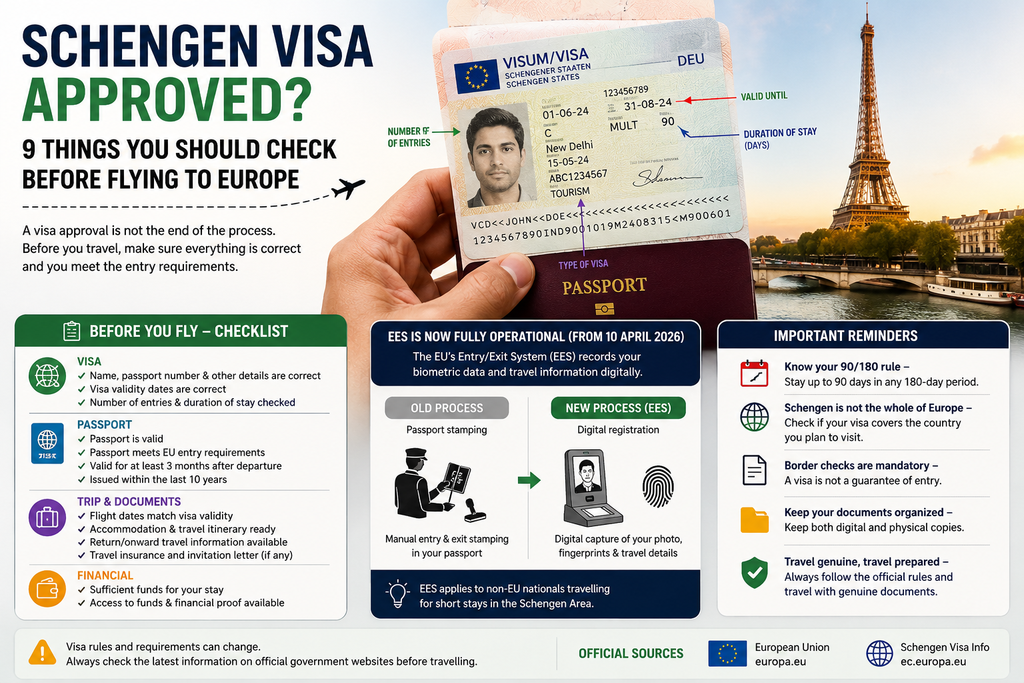
1. Don’t Just Look at the Visa Sticker — Read It
When your passport comes back, don’t simply look at the word “approved.”
Take a few minutes to check the information printed on the visa.
Look at:
- Your name
- Passport number
- Visa validity dates
- Number of entries
- Duration of stay
- Territorial validity, where applicable
A mistake in the dates or other information is something you want to notice before you are standing at the airport.
Your visa is not just a permission slip. The information printed on it tells you the conditions under which you can use it.
2. Check How Many Entries You Actually Have
This is one of those small details that can become a big problem.
A Schengen visa can have different entry permissions. For example, a visa may allow a single entry or multiple entries.
Imagine someone receives a single-entry visa.
They enter the Schengen Area, leave it for another country outside the area, and then assume they can come back using the same visa.
That’s exactly the kind of detail you should understand before planning your route.
Don’t assume that every Schengen visa works the same way.
3. Your Visa Does Not Replace Border Checks
This is probably the most important point in this article.
Having a valid visa doesn’t mean you can ignore border requirements.
EU rules state that non-EU travelers can be asked to demonstrate the purpose and conditions of their intended stay and have sufficient means of subsistence, among other entry conditions.
So keep your important travel information accessible.
Depending on your circumstances, this can include things such as:
- Accommodation information
- Return or onward travel information
- Invitation letter, if relevant
- Proof of sufficient funds
- Travel itinerary
- Passport and visa
You may not be asked for every document, but being prepared is much better than searching through your phone while standing at passport control.
4. Make Sure Your Passport Still Meets the Requirements
Your visa may be valid, but your passport still needs to meet the relevant travel-document requirements.
For short visits to the EU, the official EU guidance says a non-EU travel document should generally be valid for at least three months after the intended departure from the EU and should have been issued within the previous 10 years.
This is why you should check the passport itself rather than only looking at the visa sticker.
Before your trip, ask yourself:
“Will my passport still meet the entry requirements when I arrive and when I leave?”
5. Your Original Travel Plan Should Still Make Sense
Here’s a situation that can happen:
You applied saying you were going to spend your holiday mainly in one country.
After getting the visa, your plans completely change.
Now you’re planning a very different trip.
That doesn’t automatically mean something is wrong, but it is a good reason to review your plans carefully and make sure they remain consistent with the purpose and conditions of your visit.
The EU’s visa rules are based around the purpose and conditions of the intended stay.
Don’t create fake bookings or fake explanations just to make the trip look a certain way.
Your travel arrangements should reflect your genuine plans.
6. Know Your 90/180 Rule
For short-stay Schengen travel, the general rule is up to 90 days in any 180-day period.
That doesn’t mean you can stay 90 days, leave for a few days and automatically receive another 90 days.
The calculation works across the relevant 180-day period. The European Commission explains the short-stay rule as a maximum of 90 days in any 180-day period.
If you’ve travelled to the Schengen Area before, don’t guess your remaining days.
Check them carefully.
7. There Is a New Border System You Should Know About
This is especially important for travelers going to Europe in 2026.
The EU’s Entry/Exit System (EES) is now fully operational at external Schengen border crossing points. It applies to non-EU nationals travelling for short stays and records travel-document and biometric information such as fingerprints and facial images.
So don’t be surprised if your border experience looks different from what a friend experienced several years ago.
The system is designed to digitally record entries and exits instead of relying solely on traditional passport stamps.
8. Keep Your Important Documents Together
You don’t want your documents scattered across five different apps, email accounts and WhatsApp conversations.
Create one folder on your phone and, ideally, keep copies somewhere else too.
You could organise it like this:
01 — Passport
02 — Visa
03 — Flight
04 — Hotel / Accommodation
05 — Travel Insurance
06 — Invitation / Supporting Documents
07 — Emergency Contacts
Also keep the original documents that you actually need.
Digital copies are useful, but don’t assume a screenshot will always replace the original document.
9. Don’t Book Your Entire Trip Without Checking the Dates
This sounds obvious, but people make this mistake.
Suppose your visa starts on June 10.
You find a cheap flight for June 7.
The flight is cheaper, so you book it.
Now you have a problem.
The same applies to the final date of your authorised stay.
Always compare:
Flight dates → Visa validity → Intended stay → Passport validity
They should make sense together.
A Simple “Before Flying” Checklist
Save this checklist before your trip:
🛂 Visa
☐ Name is correct
☐ Passport number is correct
☐ Visa validity dates checked
☐ Number of entries checked
☐ Duration of stay checked
📕 Passport
☐ Passport is valid
☐ Passport meets applicable EU entry requirements
☐ Passport has the required validity after your planned departure
✈️ Trip
☐ Flight dates match visa validity
☐ Accommodation arranged
☐ Travel itinerary makes sense
☐ Return/onward travel information available
💳 Money
☐ Access to sufficient funds
☐ Relevant financial evidence available
📑 Supporting documents
☐ Invitation letter, if applicable
☐ Accommodation proof
☐ Other relevant supporting documents
☐ Copies stored securely
What If Your Plans Change After Getting the Visa?
Travel plans sometimes change.
Maybe your hotel changes.
Maybe your flight is rescheduled.
Maybe you decide to visit another Schengen country during the same trip.
Don’t panic over every small change, but don’t assume that every change is automatically irrelevant either.
The important thing is to understand your visa’s validity and the rules that apply to your intended travel.
If a major change affects the purpose, destination or conditions of your trip, check with the relevant official consulate or immigration authority rather than relying on a random social-media post.
One More Thing: Don’t Confuse Schengen With All of Europe
This is another mistake travelers make.
Europe and the Schengen Area are not exactly the same thing.
The EU’s official travel guidance lists the countries participating in the Schengen short-stay system and separately notes that Ireland and Cyprus have their own visa rules.
So before adding another European country to your itinerary, check whether your Schengen visa actually covers it.
Never assume:
“It’s in Europe, so my Schengen visa must work there.”
That’s not a safe assumption.
Final Word
Getting your Schengen visa is a big step, but it’s not the moment to stop paying attention.
Before you fly, read the visa carefully, check your passport, review your entry permissions, confirm your travel dates and keep your supporting documents organised.
And remember something many first-time travelers don’t realise:
The visa and the border entry process are two different stages.
A visa allows you to travel to the border and request entry under the applicable conditions. Border authorities can still verify whether those conditions are met.
A few minutes of checking before your trip can save you from a very stressful situation at the airport.
Travel prepared, keep your information genuine, and always verify current requirements through official government sources before departure.
❓ Frequently Asked Questions
Can I travel to every European country with a Schengen visa?
No. A Schengen visa applies to the Schengen Area under its applicable conditions. Countries outside the Schengen system can have separate visa rules. Ireland and Cyprus, for example, have their own national visa rules.
Is a Schengen visa a guarantee that I will be allowed into Europe?
No. Border authorities can verify the applicable entry conditions when you arrive.
What should I check first after receiving my visa?
Start with the visa sticker itself: your personal details, validity dates, number of entries and duration of stay.
What is the 90/180 rule?
For short-stay Schengen travel, the general limit is up to 90 days in any 180-day period.
What is EES?
The Entry/Exit System is the EU’s digital border-management system for relevant non-EU short-stay travelers. It records travel-document and biometric information at external Schengen borders and is fully operational from April 10, 2026.