

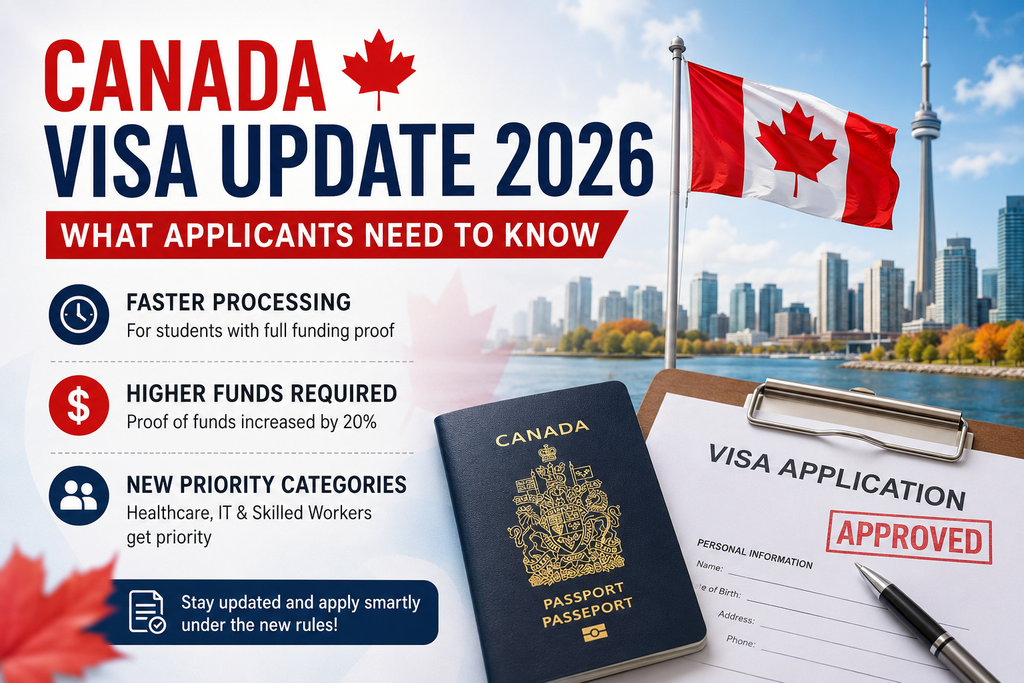
Canada Visa Update 2026: 3 Big Changes Every Applicant Must KnowCanada visa update 2026 brings 3 major changes that every applicant must know before applying. Whether you want to visit family, study, or work in Canada, IRCC has updated rules for visitor visa, study permit, and work permit. This guide explains the new requirements, fees, documents, and processing times so you can apply correctly in 2026.
The correct application depends on why you want to travel, your nationality, the type of travel document you hold and your individual circumstances. IRCC recommends checking what document you need before applying because some travelers need a visitor visa while others may need an ETA.
For this reason, preparing a Canada application should start with understanding your purpose of travel—not simply downloading a form and submitting documents.
The Viral Trend
Canada Visa Update 2026: Visitor Visa
Canada Visa Update 2026: What Type of Application Do You Need?
The first question every applicant should ask is:
“Why am I going to Canada?”
Your answer can determine which application process applies to you.
For example, someone visiting relatives may need a visitor visa, while a student planning to study at a Canadian institution may need a study permit. A person planning to work in Canada may need a work permit, depending on their situation.
There are also transit situations where a traveler may need a transit visa.
IRCC provides separate application instructions for visitors, students, workers and transit travelers, so applicants should choose the category that genuinely matches their purpose.
Canada Visitor Visa 2026
If you want to visit Canada for tourism, see family or friends, or make another temporary visit, you may need a visitor visa depending on your nationality and travel document.
A Canadian visitor visa is also known as a Temporary Resident Visa (TRV). IRCC says the visa is placed in your passport and shows that you meet the requirements needed to travel to Canada.
But getting a visitor visa does not mean that every part of your trip is automatically guaranteed.
When you arrive in Canada, a border services officer determines whether you meet the requirements to enter.
This is an important point for first-time travelers:
A visa allows you to travel to Canada and seek entry; it does not guarantee admission.
Financial Preparation for a Visitor Visa
One of the questions many applicants have is:
“How much money do I need in my bank account?”
There isn’t one universal amount that applies to every visitor.
IRCC explains that the amount of money needed can depend on factors such as how long you plan to stay and whether you will stay in a hotel or with friends or relatives.
This means applicants should avoid believing social-media posts that claim:
“You must have exactly this amount of money to get a Canada visa.”
Instead, your financial documents should make sense for your actual trip.
If you’re planning a short visit, your expenses may be different from someone planning a much longer stay.
Your financial situation should also be presented honestly and consistently.
Showing That You Will Return Home
For temporary visitors, one of the important parts of the application is demonstrating that you have reasons to return to your home country.
IRCC says applicants need to convince an immigration officer that they have ties—such as a job, home, financial assets or family—that will take them back to their country of residence. They also need to convince the officer that they will leave Canada at the end of their authorized stay.
This is why a Canada visitor visa application should not simply focus on having money.
Your overall situation matters.
For example, an applicant might have:
- A stable job
- Family responsibilities
- Property or other assets
- A clear reason for visiting Canada
- A realistic travel plan
- A defined period of stay
The important thing is that your documents and explanation should accurately represent your circumstances.
Canada Visa Update 2026: Study Permit
Canada is also a popular destination for international students.
If you plan to study in Canada, you should understand the difference between a study permit and a visitor visa.
A study permit is the document that allows an eligible foreign national to study in Canada. It is not itself a travel document.
Depending on your situation, you may also need a visitor visa or eTA to enter Canada.
Students should therefore check both sides of the process:
Permission to study + document required to travel to Canada.
Don’t assume that receiving a study permit automatically answers every entry requirement.
Choosing the Right Study Program
Before applying for a study permit, students should carefully consider their education plan.
Ask yourself:
- Why did I choose this program?
- Why did I choose this institution?
- How does it connect with my previous education?
- What are my future career goals?
- Can I realistically afford the education and living costs?
- Have I checked the institution and program requirements?
A good application should present a genuine and understandable education plan.
Students should avoid choosing a program simply because someone on social media says it is an “easy route to Canada.”
Your application should be based on your actual educational goals.
Proof of Funds for International Students
Financial preparation is especially important for students.
IRCC requires study-permit applicants to demonstrate that they have enough money to support themselves and accompanying family members during their stay, without relying on work in Canada to fund their expenses. The evidence should cover tuition, living expenses and transportation, and applicants should also explain how they plan to pay for the full duration of a program longer than one year.
The exact financial requirement can change, so students should always check the current official IRCC financial-support page before applying.
This is much safer than relying on old TikTok videos, Facebook posts or outdated blog articles.
Documents Matter More Than Many Applicants Realize
A visa application is more than a collection of files.
Your documents should support the information you provide.
Depending on the application, documents can include things such as:
- Passport
- Application forms
- Financial evidence
- Travel information
- Education documents
- Employment evidence
- Invitation letter, where relevant
- Supporting explanations
- Biometrics, where required
The exact list depends on the application type and individual circumstances.
IRCC specifically advises applicants to submit a complete application because incomplete applications can lead to delays or other problems.
Biometrics: Don’t Ignore the Request
Many Canada applicants may need to provide biometrics, which generally means fingerprints and a photograph.
IRCC explains that most applicants between 14 and 79 need to provide biometrics, although there are exceptions. Applicants who receive a biometrics instruction letter generally have 30 days from the date on the letter to complete the process.
This is why applicants should monitor their application communications after submitting.
Don’t submit your application and then forget about it.
Check for requests and respond within the required timeframe.
Canada Visa Fees
Applicants should always check the official IRCC fee page before making a payment because fees can change.
For example, the current IRCC visitor-visa application fee is listed as CAD $100 for an individual, while the biometrics fee is generally CAD $85 per individual when required.
Do not rely on an old screenshot showing a different fee.
Before paying, confirm:
Application type → Current fee → Biometrics requirement → Payment instructions
Keep your payment confirmation for your records.
Applying Online
Many Canadian temporary-resident applications can be submitted online through IRCC’s systems.
For visitor visas, IRCC provides online application options through the IRCC Portal. Applicants may need an account, electronic copies of their documents and a suitable payment method.
Before starting an online application, prepare your documents properly.
Make sure scans are:
- Clear
- Complete
- Readable
- Genuine
- In the required format
A blurry or incomplete document can create unnecessary problems.
Never Use Fake Documents
This deserves special attention.
Some applicants become desperate after hearing about visa refusals and start looking for agents who promise to “fix” their application.
Be extremely careful.
Never create fake bank statements, employment letters, education documents or other supporting evidence.
A genuine application may take more preparation, but using false documents can create much more serious problems.
If you decide to use an immigration representative, verify that the person is authorized to provide immigration services. IRCC provides information for checking whether representatives are authorized.
What About Processing Times?
There is no single processing time that applies to every Canada application.
IRCC says processing times can vary based on factors including the type of application, whether the application is complete, how easily information can be verified and how quickly the applicant responds to requests.
That’s why applicants should avoid statements like:
“Canada visa always takes exactly 30 days.”
Processing can differ by country, application type and individual circumstances.
Check the official IRCC processing-time information close to the time you apply.
Canada Visa Update 2026: Work and Express Entry
Canada also has immigration pathways for skilled workers.
Express Entry is an online system that manages applications for several economic immigration programs, including the Canadian Experience Class, Federal Skilled Worker Program and Federal Skilled Trades Program.
Canada’s 2026 Express Entry priorities include categories such as healthcare and social services, education, trades and transport, along with other category-based priorities. French-language proficiency is also part of the current category-based selection framework.
But applicants should remember:
Being in a priority occupation does not mean automatic approval.
You still need to meet the requirements of the relevant immigration program and selection process.
One of the Biggest Mistakes: Following Old Information
Canadian immigration rules can change.
A post published two years ago may contain information that is no longer accurate.
A YouTube video from last year may mention an old fee.
A Facebook post may give a financial figure that applied under a previous rule.
This is especially important in 2026 because applicants may see many posts claiming that “new rules” have suddenly changed everything.
Before acting on any immigration information, compare it with the current official IRCC information.
Use social media for awareness—but use official government sources for final verification.
Don’t Book Everything Too Early
Another practical mistake is making expensive travel arrangements before the necessary approval is secured.
If your travel plans depend on receiving a visa or permit, understand the process first.
Check:
- Application requirements
- Processing information
- Passport requirements
- Entry documents
- Biometrics
- Financial evidence
- Travel dates
Once you have the required approval and documents, make sure everything you need for travel is ready.
IRCC also notes that a valid visa and travel document do not automatically guarantee entry; travelers still need to meet Canada’s entry requirements when they arrive.
What Happens When You Arrive in Canada?
Getting approval is not necessarily the final step.
When you arrive, Canadian authorities may verify your identity and determine whether you meet the requirements to enter.
For visitors, IRCC says most visitors can stay for up to six months, but the border services officer can authorize a shorter or longer period depending on the circumstances.
This is another reason travelers should carry their important documents and understand the conditions of their stay.
Final Canada Visa 2026 Checklist
Before submitting your application, take a final look at everything.
Passport
☐ Is your passport valid?
Purpose
☐ Is your reason for traveling clearly explained?
Documents
☐ Are all required documents included?
Finances
☐ Does your financial evidence accurately represent your situation?
Information
☐ Do names, dates and other details match across your documents?
Biometrics
☐ Do you need biometrics?
Fees
☐ Have you checked the latest official fees?
Application
☐ Have you reviewed the application before submitting?
Travel
☐ Have you checked the entry requirements for your situation?
Official Sources
☐ Have you verified the latest information through IRCC?
Canada Visa Update 2026: Visitor Visa
Canada Visa Update 2026: Study Permit
Canada Visa Update 2026: Work and Express Entry
Final Thoughts: Prepare Before You Apply
A Canada visa or permit application should never be treated like a simple online form.
Your chances can depend on whether you meet the relevant requirements and whether your application provides clear, genuine and consistent information.
Whether you’re a student dreaming of studying in Canada, a visitor hoping to see family, or a professional exploring immigration opportunities, preparation is one of the most important parts of the process.
Don’t rely on rumors.
Don’t copy someone else’s application.
Don’t use fake documents.
And don’t believe anyone who promises a guaranteed visa.
Instead, understand your category, prepare your documents carefully and verify the latest requirements through official Canadian government sources.
Canada immigration rules can change, so always check the current information before you submit an application.
A better application starts with better preparation.
Disclaimer: This article is for general informational purposes only. Canadian immigration requirements, fees and procedures can change. Always verify the latest information through the official Government of Canada/IRCC website before applying. The Viral Trend does not provide individual immigration or legal services.