

You book a flight, check the price, choose your seat, and then you notice something you didn’t really think about before.
Your flight has a stop in another country.
Now the questions start.
“Mere paas final country ka visa hai. Lekin jis country mein flight ruk rahi hai, uska visa bhi chahiye?”
Sometimes you don’t need one.
Sometimes you do.
And unfortunately, there isn’t one simple rule that works for every traveller. It depends on your passport, the airport you’re changing at, your flights, and whether you actually enter the country during the stop.
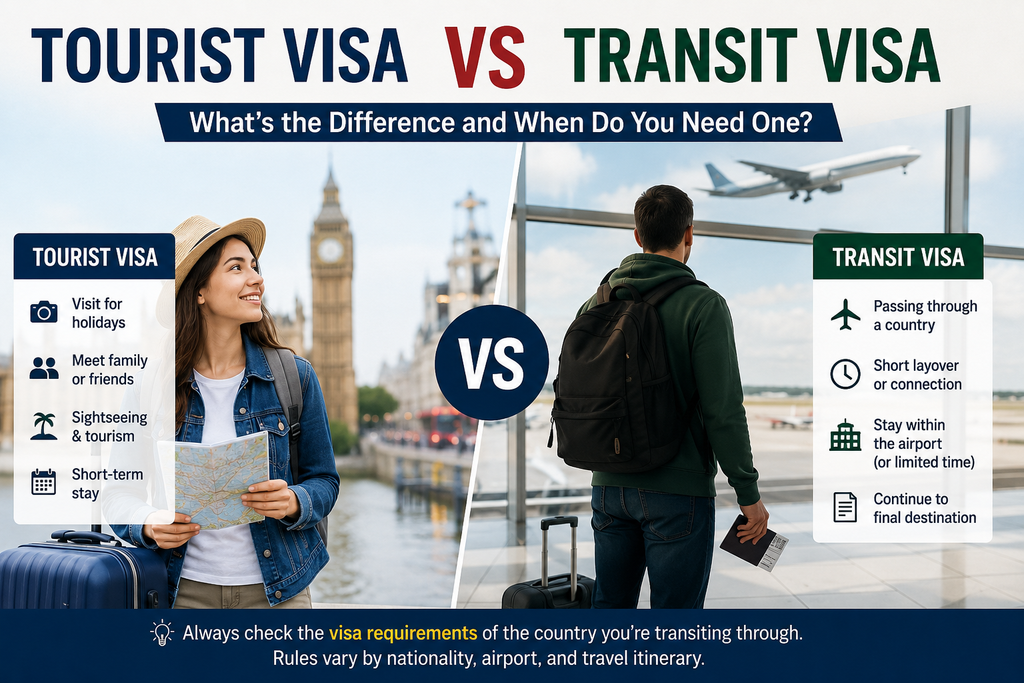
This is where the difference between a tourist visa and a transit visa becomes important.
They’re not the same thing, even though both are related to international travel.
A tourist visa is for visiting
Let’s keep this part simple.
If you’re travelling to a country because you actually want to spend time there, you’re usually looking at its visitor or tourist rules.
Maybe you’re going for a holiday. Maybe you’re visiting relatives. Maybe you’ve always wanted to see the place and finally have the chance.
For the United States, for example, tourism and visiting friends or relatives generally fall under the visitor visa category. The U.S. Department of State has a useful explanation of visitor visas and what they’re used for.
So if you’re flying to the US, staying for two weeks, visiting New York and then going back home, that’s not a transit trip.
You’re visiting the country.
A transit situation is different.
A transit visa is basically about passing through
Imagine your ticket says:
Lahore → London → Toronto
You’re not going to London for a holiday.
You’re just changing planes there before continuing to Canada.
London is your transit point.
Depending on your nationality and the way your connection works, the UK may require you to have a transit visa.
The UK has separate rules for different types of transit, so it’s worth checking the official UK transit visa guidance before assuming you’re fine.
And this is where things get slightly annoying.
Just because you’re not planning to stay in the country doesn’t automatically mean you don’t need permission to transit through it.
“I’m not leaving the airport” doesn’t always solve it
This is probably the biggest misunderstanding.
People often think:
“I’ll stay inside the airport, so obviously I don’t need a visa.”
Not necessarily.
Some airports allow passengers to connect without entering the country. You remain in the international transit area and simply wait for your next flight.
That’s often called airside transit.
But some nationalities are still required to have an airport transit visa even if they don’t leave that area.
Schengen countries are a good example. Certain travellers need an airport transit visa just to connect through a Schengen airport, depending on their nationality and circumstances. The European Commission’s Schengen visa information explains how these rules work.
So don’t look only at your layover time.
Look at the actual transit requirement.
Airside and landside — what’s that about?
You’ll probably come across these terms when researching your trip.
Airside means you stay in the airport’s international transit area and don’t go through border control.
Landside means you pass through immigration and enter the country.
Why should you care?
Because your visa situation can change depending on which one applies to you.
Let’s say you land in London and your next flight is four hours later.
If everything is on one booking, your bags are checked through, and you can remain airside, your situation may be relatively straightforward.
But now imagine you booked two separate flights.
You land.
You collect your suitcase.
You need to check in again for the second flight.
You may now have to pass through border control.
That’s a very different situation.
The UK government specifically explains the difference between airside and landside transit in its layovers and transit guidance.
Your final destination visa doesn’t automatically cover your connection
This is worth remembering.
Let’s say you have a valid Canadian visa.
Great.
But your journey is:
Pakistan → UK → Canada
Your Canadian visa deals with your entry into Canada. It doesn’t automatically give you permission to enter or transit through the UK.
You still have to check the UK rules.
The same idea applies when travelling through the United States, Schengen Area, or another country.
Think about the journey in pieces.
Where are you starting?
Where are you changing planes?
Where are you actually going to stay?
Each part can have its own immigration rules.
What happens if your connection is in the United States?
The US has a specific category called a C transit visa.
It’s intended for certain foreign nationals travelling through the United States while continuing to another country.
The U.S. Department of State explains the US transit visa rules here.
For example, suppose you’re travelling:
Dubai → New York → Mexico City
New York isn’t your destination. You’re simply connecting there.
That’s where transit rules come into the picture.
But there’s an important catch.
If your plan is actually to leave the airport, visit friends, go sightseeing or spend some time in the US, you’re no longer talking about a simple transit purpose.
That’s when you need to look at the appropriate visitor rules instead.
In other words, don’t choose a transit visa just because your flight happens to have a connection.
The reason you’re entering or passing through the country matters.
Long layover? Be careful before leaving the airport
A long layover can look tempting.
You have eight or ten hours.
You think, “Why sit at the airport all day? I’ll go into the city for a few hours.”
Fair enough.
But first find out whether you’re actually allowed to leave.
Leaving the airport can mean passing through immigration. If you’re not visa-exempt, you may need a visa or another form of permission to enter.
And this is one of those things you really don’t want to discover at the immigration counter.
So if you have a long connection and you’re thinking about going sightseeing, check the entry requirements before making the plan.
Separate tickets are another thing to watch
Here’s a situation people don’t always consider when hunting for the cheapest flight.
You find two cheap tickets:
Flight 1: Islamabad → London
Flight 2: London → Paris
They look like a normal connection.
But they’re actually separate bookings.
Now you might have to collect your luggage in London and check in again.
If that requires you to go through immigration, your transit situation changes.
This is why I wouldn’t look only at the flight time when checking visa requirements.
Look at the booking itself.
Are both flights on the same ticket?
Does your baggage go all the way through?
Do you need to change terminals?
Do you need to change airports?
Will you have to go through border control?
These little details can make a big difference.
What about a Schengen airport connection?
Schengen travel has its own terminology, which can make things even more confusing.
A normal Schengen short-stay visa and an airport transit visa aren’t interchangeable.
An airport transit visa is mainly about allowing certain travellers to pass through the international transit area of an airport without entering the Schengen country.
The European Commission explains that short-stay Schengen visas can cover stays of up to 90 days in a 180-day period, while airport transit visas have a much narrower purpose.
And again, not everybody needs an airport transit visa.
Your nationality matters.
Your route matters.
The airport can matter too.
So if you’re connecting somewhere in Europe, don’t just search “Schengen visa” and assume you’ve found the answer.
Check whether your particular trip falls under airport transit or entry into the Schengen Area.
What should you check before buying the ticket?
Honestly, this takes only a few minutes and can save you a lot of trouble later.
Before paying for your flight, check these things:
Your passport: Visa rules are often based on nationality.
Your connecting airport: Don’t assume every airport in the same country has exactly the same transit process.
Your final destination: Make sure you can legally enter the country you’re travelling to.
Your tickets: Separate tickets can create additional immigration and baggage issues.
Your baggage: Find out whether it will be checked through or you’ll have to collect it.
Your connection: See whether you’ll remain airside or need to pass through border control.
Your layover: If you plan to leave the airport, check entry rules rather than only transit rules.
For UK travel, for instance, the government asks applicants to provide evidence relating to their onward journey and permission to enter the destination when applicable.
A few examples that make the difference clearer
Let’s make it real.
You’re going to Canada through London
You have a Canadian visa and your flight is:
Pakistan → London → Toronto
You’re visiting Canada.
London is only the connection.
You should therefore check whether your nationality and particular flight require a UK transit visa.
You’re going to Dubai for a holiday
Your flight is:
Pakistan → Dubai
You’re staying for a week.
That’s a visitor/tourist situation, not transit.
You need to follow Dubai/UAE entry requirements that apply to your passport.
You’re travelling to Australia through Europe
Your flight is:
Pakistan → Frankfurt → Sydney
You’re only changing planes in Frankfurt.
Now you need to check the relevant airport transit rules for your nationality and exact connection.
Don’t assume that because you’re not visiting Germany, nothing is required.
You have a 12-hour stop and want to explore
That’s where you need to slow down and check things properly.
If sightseeing means leaving the airport and passing immigration, you need to be allowed to enter the country.
A transit arrangement doesn’t automatically give you tourist-entry privileges.
So which visa do you actually need?
There isn’t a universal answer.
If you’re visiting the country, you’re generally looking at its visitor/tourist rules.
If you’re only passing through, you may fall under transit rules.
If you’re staying inside the international transit area, an airport transit visa may apply in some cases.
And if you need to pass through immigration, collect your bags, change airports, or spend time outside the airport, you may need permission to enter the country.
That’s why simply asking, “Do I need a transit visa?” isn’t always enough.
The better question is:
“For my passport and this exact flight, what do I need to legally make this connection?”
That’s the question I’d check before booking.
If you’re new to visa planning, you can also read our guide on how to travel to another country using a visa for the bigger picture.
Don’t rely on an old answer from social media
One final thing.
Visa rules change.
Airlines change their requirements. Countries update their visa policies. Your nationality can also make a huge difference.
So if someone tells you, “Don’t worry bro, you never need a transit visa,” don’t take that as the final answer.
Check the official source for your route.
For the UK, start with the official UK transit visa page. For Schengen travel, check the European Commission’s current visa guidance. And for US connections, the U.S. Department of State transit information is the better place to start.
A random post from 2023 might have been correct back then. That doesn’t mean it’s correct for your flight today.
Bottom line
A tourist visa and a transit visa aren’t two versions of the same thing.
A tourist visa is generally about visiting a country.
A transit visa is generally about passing through a country on your way somewhere else.
But the tricky part is figuring out what counts as transit for your specific journey.
Before you fly, check your passport nationality, connecting airport, ticket type, baggage arrangements and whether you’ll need to pass immigration.
It sounds like a lot.
In reality, it’s better than reaching the airport and finding out you’ve missed one important visa requirement.
And if you’re planning a trip, don’t forget to check your visa documents alongside your flights. Your final destination visa is only one piece of the puzzle.