

Planning a trip to the United States? Here are the things that can make your tourist visa application clearer, more convincing, and easier to understand.
Applying for a U.S. tourist visa can be a little confusing. You search online for advice and end up finding ten different answers to the same question.
One person tells you that you need a very large bank balance. Someone else says you must have an invitation letter from America. Then you watch a few visa interview videos and suddenly it feels like you need to memorize the “perfect” answer to every possible question.
It doesn’t really work that way.
A visitor visa application is about your individual circumstances. The U.S. Department of State says officers may consider things such as the purpose of your trip, your intention to leave the United States after the visit, and your ability to pay for the trip.
That means there isn’t one magic document or one magic answer that works for everyone.
If you’re preparing a U.S. tourist visa application, these are some of the things worth paying attention to.
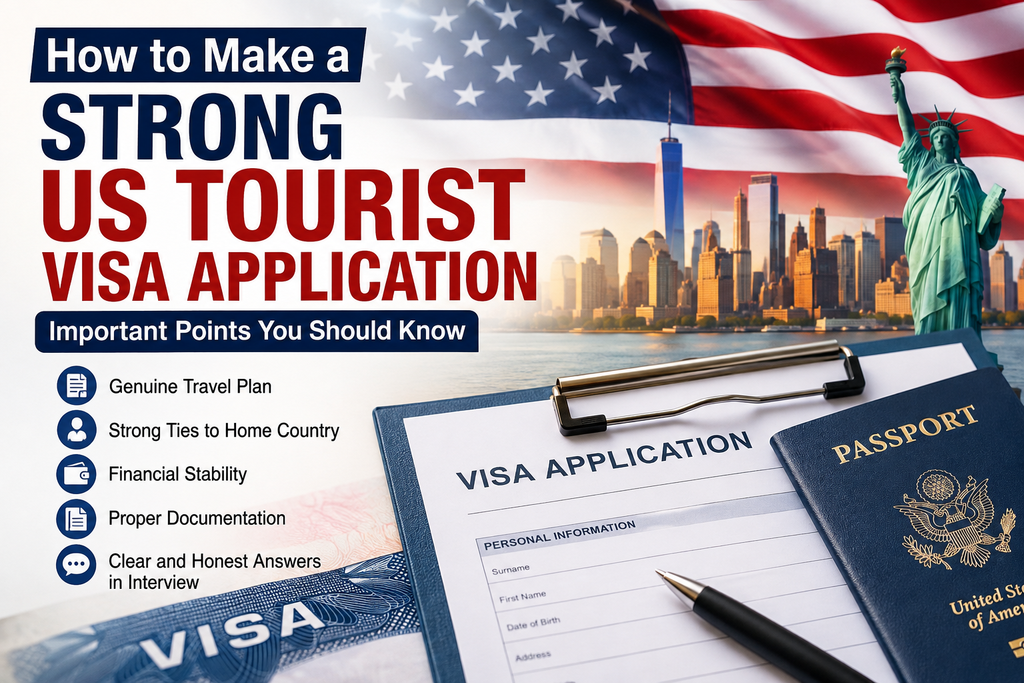
First, Be Clear About Why You Want to Visit
Start with the simplest question: Why are you going to the United States?
It sounds obvious, but applicants sometimes make their travel plans more complicated than they need to be.
If you’re going for a vacation, say that. If you want to visit your brother and spend some time sightseeing, that’s your reason. If you have been planning a family holiday for a while, explain the trip honestly.
There is no need to invent an impressive reason.
For example, someone might want to visit New York for two weeks, see Times Square, visit museums, spend a few days in Washington, D.C., and then return home. That’s a perfectly understandable tourism plan.
Your own trip may look completely different.
The important part is that your reason for visiting should be genuine and should make sense for your circumstances.
A short holiday should also look like a short holiday. You don’t need to create a complicated itinerary just because you think a long list of destinations will impress someone.
Don’t Fill Out the DS-160 in a Hurry
The DS-160 is one of those forms where taking an extra bit of time can save you from unnecessary trouble later.
It asks for a lot of information, and the details you provide can become part of the visa process. The Department of State advises applicants to answer the questions accurately and completely.
So, before you submit it, go back and check everything.
Look at your employment details. Check your dates. Review your travel information. Make sure names and addresses are correct. If you’ve traveled internationally before, make sure that information is entered accurately.
Don’t guess when you’re unsure about a detail.
And don’t change your personal history just because you think another answer sounds better.
A tourist visa application isn’t a competition to see who can create the most impressive profile. It’s your application, so the information should reflect your actual life.
Your Money Should Make Sense
Here’s where a lot of applicants get stuck.
They ask, “How much money do I need in my bank account?”
There isn’t a universal bank balance that guarantees a U.S. tourist visa.
Think about it this way. If you are planning a relatively short vacation, your financial situation should reasonably support that vacation. The source of the money should also be understandable.
Suppose you have been working for several years and regularly saving part of your salary. Your savings have grown gradually, and now you want to use some of that money for a holiday.
That’s a straightforward situation.
On the other hand, if a large amount suddenly appears in your account just before you apply and you have no reasonable explanation for it, you may have a harder time explaining your finances if asked.
The State Department says applicants may be asked for evidence of their ability to pay the costs of the trip. If someone else is paying for some or all of the trip, evidence of that arrangement can also be relevant.
So don’t concentrate only on the final number in your bank statement.
Think about the story behind the money.
Where did it come from? Does it fit your normal income and circumstances? Does the amount make sense for the trip you’re planning?
Those are much more useful questions.
Your Life Back Home Is Part of the Picture
This is probably one of the most important things for a visitor visa applicant to understand.
You’re applying for temporary travel, not permanent residence.
U.S. law includes a presumption of immigrant intent for applicants seeking nonimmigrant visas. Under Section 214(b), an applicant can be refused if they don’t establish eligibility for the requested nonimmigrant classification or don’t overcome that presumption.
So the officer may look at the bigger picture of your life.
What do you do at home?
Do you have a job? A business? Studies? Family responsibilities? A home? Other commitments?
These things are different for everyone.
A person who has worked at the same company for years may have a different set of circumstances from a university student. A business owner will have a different situation from a retired traveler.
There isn’t a single “strong ties” document that everybody needs.
Your job is simply to be able to explain your real circumstances.
If You Have a Job, Know Your Own Job
This sounds almost too simple, but it matters.
If you tell the officer that you’re employed, you should be comfortable explaining what you actually do.
You should know the name of your employer, your position, roughly how long you’ve worked there, and what your normal responsibilities are.
You don’t need to give a five-minute presentation.
If someone asks, “What do you do?” you can answer naturally.
For example:
“I work as a sales manager for a private company. I’ve been working there for about four years.”
That’s enough to start the conversation.
If the officer wants more information, they’ll ask.
The same goes for business owners. Know what your business does, how long you’ve been running it, and what your role is.
Don’t Worry About Having the “Perfect” Interview Answer
The internet is full of videos about U.S. visa interviews.
Some are helpful. Others can make applicants even more nervous.
You may see someone saying that you should answer a particular question in exactly a particular way.
Try not to fall into that trap.
Your answer should come from your own situation.
If you’re asked why you want to visit America, explain your actual reason.
If you’re asked how long you’re staying, give your intended length of stay.
If you’re asked who is paying, explain the actual arrangement.
That’s much better than repeating an answer you memorized from somebody else’s interview.
A consular interview is a conversation about your application and your circumstances. Someone else’s perfect answer may not make sense for you at all.
Short Answers Are Often Easier to Understand
Being prepared doesn’t mean talking a lot.
In fact, applicants sometimes make themselves more nervous by trying to explain everything before the officer has even asked.
Imagine you’re asked:
“How long are you planning to stay?”
You don’t need to explain your entire travel history.
Just answer the question.
“Around two weeks.”
If the officer wants to know where you’re staying or what you’re planning to do, they’ll ask.
This doesn’t mean you should hide information. It simply means you should listen carefully and answer what you’re being asked.
Don’t Memorize Your DS-160 Word for Word
You should know what you put in your application, but you don’t need to memorize the entire form.
Before your interview, take some time to review the important sections.
Pay particular attention to your:
- Employment information
- Travel plans
- Previous travel
- Family information
- Contact details
- Other significant information you provided
The reason is simple: you don’t want to be surprised by your own application.
If an officer asks a question about something you entered on the DS-160, you should be able to explain it naturally.
What About Relatives in the United States?
Having a relative in America does not automatically make a tourist visa application either strong or weak.
What matters is the full situation.
If your sister lives in California and you’re genuinely visiting her for a family trip, don’t hide that fact.
At the same time, don’t assume that her invitation is enough to get you a visa.
The Department of State says a letter of invitation or Affidavit of Support is not required to apply for a visitor visa. It also explains that applicants qualify based on their own ties abroad rather than assurances from family and friends in the United States.
So if you’re visiting someone, be honest about it. Just don’t treat an invitation letter as a guarantee.
Keep Your Documents Organized, Not Overloaded
There’s nothing wrong with being prepared.
But taking a huge pile of unrelated documents to the interview doesn’t automatically make an application stronger.
The required documents can vary depending on your circumstances and the embassy or consulate where you’re applying. The Department of State lists a passport, DS-160 confirmation page, required fee receipt, and photo requirements among the basic visitor visa documentation.
Beyond that, supporting documents should actually support something.
For example, documents relating to your employment, finances, business, education, or other circumstances may help explain your situation when relevant.
Don’t collect paperwork just for the sake of having more paperwork.
A well-organized set of relevant documents is much more useful than a folder full of things you can’t explain.
Never Use Fake Documents
This should be obvious, but it still needs to be said because applicants sometimes get bad advice from unofficial agents.
Don’t create fake bank statements.
Don’t make fake employment letters.
Don’t invent property ownership.
Don’t create a fake travel history.
And don’t ask someone to prepare false documents on your behalf.
Trying to make your application look stronger through false information can create a much bigger problem than having an ordinary profile.
The Department of State warns that fraud or willful misrepresentation can have serious immigration consequences.
If your circumstances aren’t perfect, deal with the real circumstances.
Honesty is far safer than a made-up story.
What If You Don’t Have Much Travel History?
You may have heard that people with lots of previous international travel have an advantage.
Don’t let that make you feel that you need to create a travel history.
If you haven’t traveled abroad much, that’s simply your history.
Not everyone has the same opportunities to travel.
If you have previous international trips, provide accurate information. If you don’t, don’t invent any.
Your application should be based on what you’ve actually done, not what you think a visa officer wants to hear.
Make Sure Your Travel Plans Match Your Situation
This is an area applicants often overlook.
Imagine someone who has a full-time job and plans to take a two-week vacation.
That sounds like a normal use of annual leave.
Now imagine the same person saying they want to stay in America for six months without explaining why they would be away from work for that long.
Naturally, that could lead to questions.
Again, this doesn’t mean there’s one specific trip length that guarantees approval.
It simply means your plans should be understandable when viewed alongside the rest of your application.
Your job, finances, family situation, travel plans and intended length of stay should all fit together.
Don’t Apply Just Because Someone Told You “You Will Get It”
You’ll probably come across people who claim they can guarantee a U.S. visa.
Be careful.
No agent, consultant, travel company, friend or relative can promise that a consular officer will approve your application.
There is no secret form.
There is no magic bank balance.
And there isn’t a sentence you can memorize that guarantees success.
Good preparation can make you more confident and help you present your circumstances clearly, but the decision is made based on the individual case.
Choose the Right Visa Category
Before applying, make sure a visitor visa actually matches what you plan to do.
A B-2 visitor visa can be used for temporary tourism and certain other visitor purposes. A combined B-1/B-2 visa can cover permitted temporary business and tourism activities. But a visitor visa isn’t meant to be used for ordinary employment or permanent relocation.
This is worth thinking about before you spend money on an application.
Ask yourself what you actually intend to do in the United States.
If your real purpose doesn’t fit a visitor visa, look into the appropriate visa category instead.
What Should You Do a Few Days Before the Interview?
You don’t need to spend the final few days memorizing hundreds of possible questions.
Instead, go over the basics.
Look at your DS-160 again.
Review your travel plan.
Know who is paying for the trip.
Be familiar with your employment or business details.
Think about your plans after returning home.
Then stop overthinking it.
You don’t need to turn your answers into a speech.
If you’re nervous, that’s okay.
Listen to the question, take a second if you need it, and answer honestly.
One More Thing: Don’t Try to Sound Richer Than You Are
This is worth mentioning because social media can create a strange idea of what a “strong applicant” looks like.
You don’t need to pretend that you have a huge business, expensive properties, or a massive savings account.
If your actual circumstances are ordinary, that’s okay.
A person with a normal job, reasonable savings and a genuine vacation plan is still a real traveler.
Your application should explain your actual situation, not somebody else’s idea of what a successful applicant looks like.
What Makes an Application Feel Strong Overall?
There isn’t a single box you can tick and say, “Now my visa is guaranteed.”
Instead, look at your application as one complete picture.
Your reason for traveling should be genuine.
Your DS-160 should be accurate.
Your finances should be understandable.
Your plans should fit the amount of time you’re requesting.
Your answers should be consistent.
And your circumstances at home should make sense for someone planning a temporary trip.
When these pieces fit together naturally, you have a much clearer application.
A Quick Check Before You Submit
Before you finish your application, ask yourself a few honest questions.
Why am I going to the United States?
Can I explain the reason without making up anything?
Who is paying for the trip?
Can I explain the source of the money?
What do I do at home?
Can I comfortably explain my job, business, studies, or other responsibilities?
How long will I stay?
Does that length of stay make sense for my circumstances?
What happens after the trip?
Can I explain my genuine plans after returning home?
And finally:
Is everything in my application truthful?
If the answer to all of these is yes, you’ve at least taken care of some of the most important parts that are within your control.
Final Word
Getting a U.S. tourist visa isn’t about finding a secret formula.
A lot of the advice you see online makes the process sound more complicated than it really is. People talk about exact bank balances, invitation letters, special interview answers and “guaranteed” methods.
It’s better to step away from all that noise and look at your own situation.
Why are you traveling? How will you pay for the trip? What do you do at home? How long are you planning to stay? And can you explain your application honestly?
Those are the questions you should spend your time preparing for.
There is never a guarantee that an application will be approved, because visa decisions are made on individual circumstances. But you can make your part stronger by being accurate, prepared, realistic and honest.
And perhaps the most useful advice is also the simplest one:
Don’t build your application around what you think the officer wants to hear. Build it around the truth about your own trip and your own life.
Frequently Asked Questions
How much money should I have for a U.S. tourist visa?
There is no single bank-balance amount that guarantees approval. Your finances should reasonably support your proposed trip, and you should be able to explain where the travel funds come from.
Is an invitation letter required for a U.S. tourist visa?
No. The U.S. Department of State says an invitation letter or Affidavit of Support is not required for a visitor visa application.
Do I need previous international travel to apply?
No. If you have limited travel history, simply provide truthful information about your previous travel.
Should I memorize interview answers?
No. Understanding your own application is more useful than memorizing scripted answers.
What is the most important thing in a tourist visa application?
There isn’t one single factor. The overall application should clearly and truthfully explain your temporary travel purpose, financial circumstances, and situation at home.
Can anyone guarantee a U.S. tourist visa?
No. Be cautious of anyone promising guaranteed approval or claiming to have a secret method for getting a visa.