

Applying for an Australia Visitor Visa can feel confusing because there are so many documents people recommend online.
Some applicants collect a huge number of papers thinking that more documents automatically mean a stronger application. Others focus only on their bank statement and forget to explain why they are visiting Australia and why they will return home.
The better approach is to understand what each document is actually showing about you as a visitor.
For the Australia Visitor visa (subclass 600) Tourist stream, you need to show that you genuinely intend to visit temporarily, have enough money for your stay, and meet the other visa requirements.
So, which documents deserve the most attention?
1. Your Passport and Identity Documents
Start with the basics.
You should provide the relevant pages of your current passport showing your photograph, personal information and passport issue and expiry dates. If applicable, you may also need to provide a national identity card or documents explaining a change of name, such as a marriage or divorce certificate.
This sounds simple, but small inconsistencies in personal information can create unnecessary problems.
Before uploading your documents, check that your name, date of birth and other details match the information in your application.
2. Bank Statements: Don’t Just Show a Balance
Your financial documents can be important, but the story behind the money matters too.
Australian Home Affairs specifically gives examples such as itemised personal bank statements covering a three-month period, payslips, audited accounts, tax records, term deposits and credit-card statements as evidence that you have enough money for your stay and to leave Australia.
This means applicants shouldn’t think only in terms of:
“How much money do I need?”
A better question is:
“Can I clearly show where my money comes from and that it reasonably supports my planned trip?”
For an employed applicant, regular salary deposits and payslips can help explain their financial position.
For a business owner, business records and tax documents may provide a better picture of their income.
The important thing is that the evidence should reflect your real financial circumstances.
3. Proof of Employment Can Be Very Useful
If you have a job in your home country, don’t overlook it.
A letter from your employer confirming your position and that you are expected to return to work can help demonstrate your circumstances at home. Australian Home Affairs specifically lists an employer letter as an example of evidence showing reasons to return.
A useful employment letter could explain things such as:
- Your job title
- Your employment status
- How long you have worked there
- Approved leave for the trip
- Expected return to work
Don’t create information simply to make the application look stronger. The documents should be genuine and consistent with your application.
4. Business Owners Have Different Evidence
If you’re self-employed or run a business, an employment letter obviously won’t describe your situation.
Instead, you may want to provide genuine evidence showing that you operate a business and have reasons to return to it.
Depending on your circumstances, this could include relevant business records, tax documents or other evidence of your ongoing activities.
The goal isn’t to upload every document you have ever received.
The goal is to provide clear evidence that explains your actual situation.
5. Your Travel Plans Matter
Another important part of the application is explaining what you actually plan to do in Australia.
Australian Home Affairs asks applicants to provide their plans while in Australia as part of evidence supporting a genuine temporary visit.
That doesn’t mean you need to create a complicated 20-page itinerary.
A simple and realistic plan can be much easier to understand.
For example:
Sydney → Melbourne → return home
You can explain the approximate dates, places you want to visit and the purpose of the trip.
Your travel plan should also make sense alongside your finances and requested stay.
6. Family or Friend Invitation Letters
Planning to stay with a relative or friend in Australia?
An invitation letter can be useful supporting evidence.
According to Australian Home Affairs, the letter can explain:
- Your relationship with the person
- Why they are inviting you
- How long you plan to visit
- Whether you will stay with them
If that person will pay for your stay, evidence of their financial situation may also be relevant.
But an invitation letter doesn’t automatically guarantee a visa.
You still need to satisfy the requirements of the visitor visa.
7. Proof That You Have Reasons to Return Home
This is one of the most important parts of preparing a visitor visa application.
Australia’s official guidance gives several examples of evidence that can demonstrate reasons to return home, including:
- An employer letter
- Proof of study
- Immediate family connections
- Proof that you can return home
- Evidence of owning a house or other major assets
Think about your situation as a whole.
If you have a stable job, ongoing studies, a business, close family responsibilities or significant assets, provide genuine evidence where relevant.
Don’t manufacture ties that don’t exist.
8. Property Documents Can Support Your Situation
Owning a house or other major assets in your home country can be relevant evidence.
But property ownership shouldn’t be treated as a magic document.
A person doesn’t automatically qualify for an Australian visitor visa simply because they own property.
It’s better to think of property documents as one part of the overall picture.
Your finances, travel purpose, personal circumstances and other evidence should tell a consistent story.
9. Students Should Show Their Study Situation
If you’re a student, your documents will naturally look different from those of an employee.
Proof that you are enrolled at a school, college or university in your home country can help demonstrate your circumstances and reasons to return.
Australian Home Affairs specifically lists proof of study as an example of evidence supporting your reasons to return home.
If you’re taking a short holiday during a genuine study break, your application should explain that clearly.
10. Don’t Upload Random Documents Just to Make the File Bigger
This is a common mistake.
A bigger PDF doesn’t necessarily mean a stronger application.
Australian Home Affairs says applicants should provide as much information as possible to support their application and notes that applications may be decided without requesting additional information.
So instead of uploading random files, ask:
What does this document prove?
If you have a bank statement, it should help explain your finances.
If you have an employer letter, it should help explain your employment.
If you have a travel plan, it should help explain your intended visit.
That is a much more useful way to organise an application.
What About Documents Not Written in English?
This is another point applicants should not ignore.
Australian Home Affairs says non-English documents should be translated into English and that both the original and translated documents should be provided. The translation requirements differ depending on whether the translator is in Australia or overseas.
So if your important supporting documents are in another language, check the current translation instructions before uploading them.
Also make sure scans or photographs are clear and readable.
What If You Are Being Sponsored by Someone?
Sometimes an applicant’s trip is being paid for by a family member, friend or another person.
In that situation, don’t simply upload the sponsor’s bank statement and leave everything unexplained.
Explain the relationship and the reason the person is supporting your trip.
If an Australian relative or friend is inviting you and paying for your stay, Australian Home Affairs says evidence of their funds can also be provided.
The application should make it clear:
Why are they paying?
What is your relationship with them?
What is your planned visit?
The Most Important Thing: Consistency
Imagine your application says you earn a certain amount every month.
Your bank statements show something completely different.
Your travel plan is expensive.
Your requested stay is long.
And your employment documents don’t clearly explain your leave.
That can make the overall application harder to understand.
On the other hand, when your travel purpose, finances, employment, documents and personal circumstances make sense together, the application is easier to assess.
That’s why preparing a visitor visa application isn’t simply about collecting documents.
It’s about presenting your genuine situation clearly.
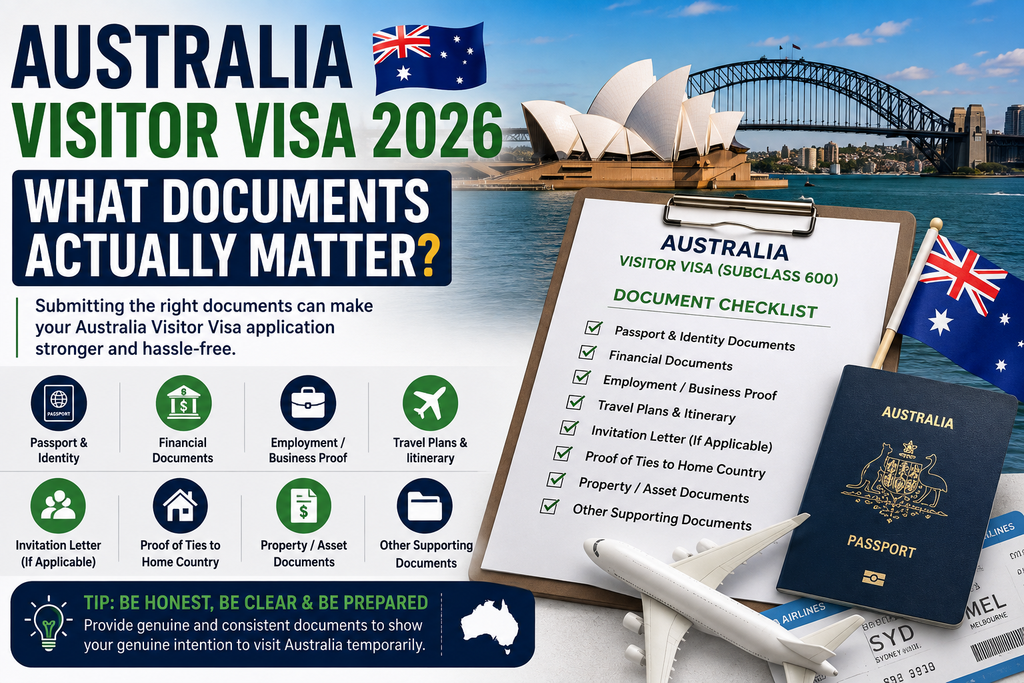
Australia Visitor Visa Document Checklist
Before submitting your application, you can use this simple checklist as a starting point:
Identity
☑ Current passport
☑ National identity document, where applicable
☑ Name-change documents, if applicable
Financial
☑ Personal bank statements
☑ Payslips
☑ Tax records
☑ Term deposits, if relevant
☑ Other genuine evidence of available funds
Employment / Business
☑ Employer letter
☑ Proof of approved leave
☑ Business records, where relevant
☑ Evidence of ongoing employment or business
Travel
☑ Travel plans
☑ Intended activities
☑ Accommodation information, where relevant
Home-country ties
☑ Employment evidence
☑ Study evidence
☑ Family connections
☑ Property or major asset evidence, where relevant
Invitation / Sponsorship
☑ Invitation letter, if applicable
☑ Evidence of relationship
☑ Sponsor’s financial evidence, if they are paying
Translations
☑ English translations for non-English documents
☑ Original documents
☑ Clear colour scans or photographs
These are examples based on the Australian government’s current guidance; your personal document requirements can vary.
Final Thoughts
There isn’t one magical document that guarantees an Australian Visitor Visa.
A strong application is better understood as a complete and believable picture of your temporary visit.
Your passport proves your identity.
Your financial documents explain how you can support the trip.
Your travel plan explains why you’re going.
Your employment, study, family or property evidence can help explain your circumstances at home.
And your invitation or sponsorship documents can explain who you’re visiting and who is supporting the trip.
The best approach is simple: be honest, provide relevant evidence, keep your information consistent, and avoid unnecessary documents that don’t actually support your application.
For the latest requirements, always check the Australian Department of Home Affairs before submitting an application because visa rules and document requirements can change.
Frequently Asked Questions
How much bank balance is required for an Australia Visitor Visa?
There is no single universal bank-balance figure stated on the official Tourist stream page. Applicants must have, or have access to, enough money to support themselves during their stay and to leave Australia. Evidence can include bank statements, payslips, tax records and other financial documents.
Is an invitation letter mandatory?
Not necessarily. An invitation letter can support an application when you’re visiting family or friends, but it isn’t a substitute for meeting the visa requirements.
Can I work on an Australian Visitor Visa?
No. The Tourist stream of the Visitor visa does not allow you to work in Australia.
Can I study in Australia on this visa?
You can study or train for up to three months on the Tourist stream, although a student visa may be more appropriate if studying is your main reason for travelling.
How long can I stay?
The stay period is decided case by case. The Tourist stream generally allows a stay of three months, although stays of up to 12 months can be granted in certain circumstances.